


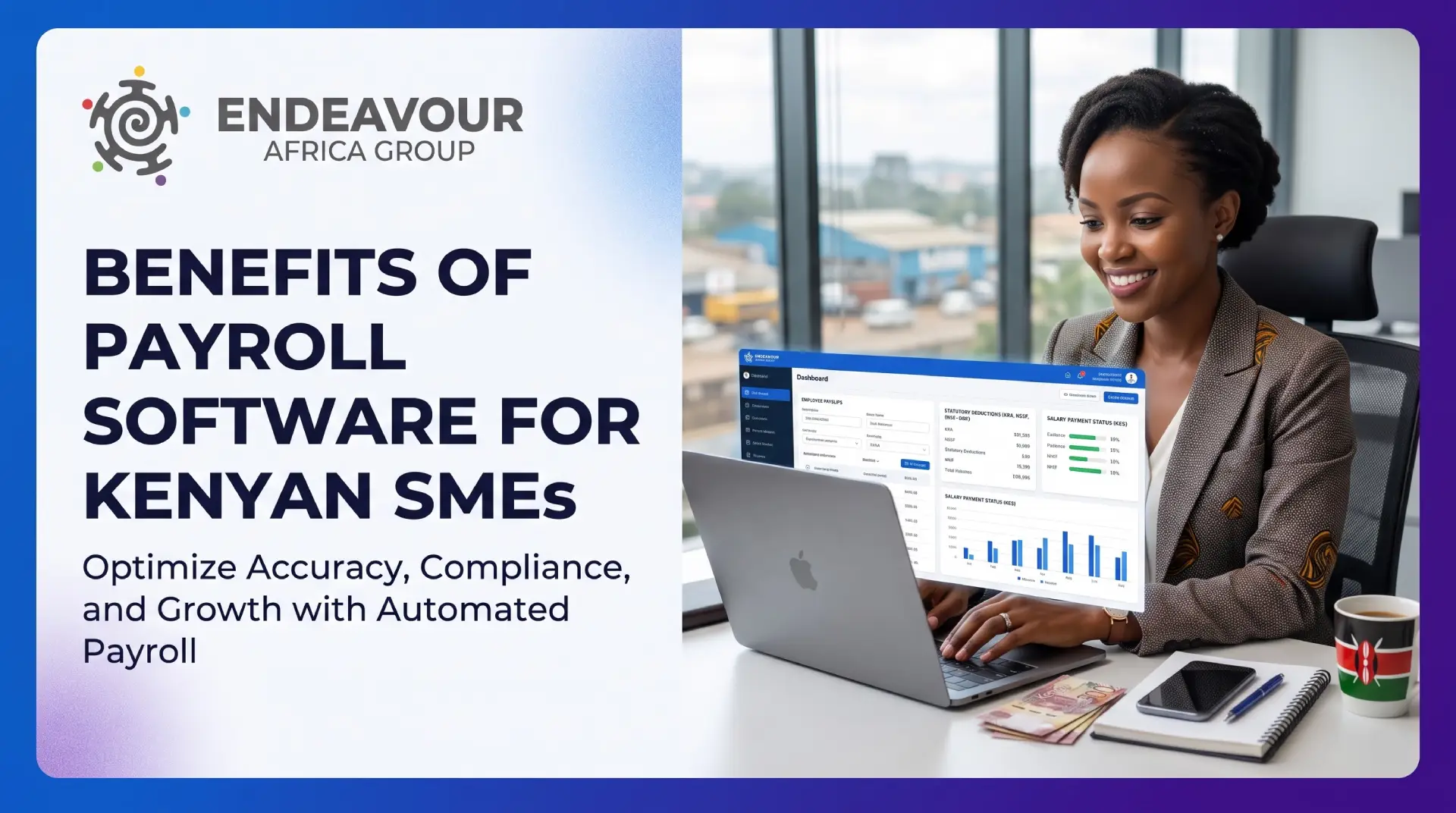
For many small and medium-sized businesses, payroll is still managed using spreadsheets, manual calculations, and disconnected records. As the number of employees grows, this approach can become time-consuming and increase the risk of payroll errors.
Using payroll software for SMEs in Kenya can help businesses automate routine payroll tasks, improve accuracy, maintain employee records, and simplify payroll administration.
What Is Payroll Software?
Payroll software in Kenya is a digital solution that helps businesses manage employee salaries, deductions, payslips, payroll records, and other payroll-related processes from one system.
Instead of calculating every employee’s salary manually, businesses can use a payroll management software Kenya solution to streamline repetitive tasks and create a more organized payroll process.
For growing SMEs, this can provide better control over payroll while reducing the administrative workload.
1. Saves Time on Payroll Processing
Processing payroll manually can take significant time, particularly when a business has many employees.
Payroll software can automate calculations and routine payroll activities, allowing HR and finance teams to spend less time working with spreadsheets and more time focusing on important business activities.
A reliable payroll system in Kenya can make recurring payroll processing more structured and efficient.
2. Reduces Payroll Calculation Errors
Salary calculations involve multiple components, including basic salary, allowances, deductions, statutory contributions, and other adjustments.
A small manual error can result in an incorrect employee payment or require additional reconciliation.
With automated payroll software in Kenya, calculations can be handled systematically based on the information and configuration maintained in the system.
This helps SMEs reduce avoidable payroll errors and improve consistency.
3. Simplifies Statutory Deduction Management
Kenyan businesses need to manage applicable statutory payroll deductions and contributions accurately.
Managing these calculations manually can become complicated as requirements change.
A suitable payroll solution in Kenya can help businesses organize applicable deductions and payroll information within a centralized system, making payroll administration easier to manage.
Businesses should still ensure that their payroll software is properly configured and kept up to date with current requirements.
4. Generates Employee Payslips Easily
Creating payslips manually for every employee can add unnecessary administrative work.
Payroll software can generate structured payslips based on processed payroll data, giving employees a clear breakdown of their earnings and deductions.
This improves transparency and makes payroll records easier for both employees and administrators to manage.
5. Keeps Employee Payroll Records Organized
SMEs often maintain employee information across spreadsheets, documents, and separate systems.
A centralized payroll management system in Kenya can keep important payroll information organized in one place.
This makes it easier to access employee salary information, payroll history, deductions, and other relevant records when required.
6. Supports Business Growth
A payroll process that works for 10 employees may become difficult to manage when the company grows to 50, 100, or more employees.
Payroll software provides SMEs with a more scalable approach to payroll management.
Instead of continually adding spreadsheets and manual processes, businesses can use a structured payroll system in Kenya that supports their growing workforce.
7. Improves Payroll Accuracy and Control
Payroll is directly connected to employee satisfaction and business finances.
Employees expect their salaries to be processed accurately and on time. At the same time, business owners need visibility into payroll costs.
Using the best payroll software in Kenya can help SMEs establish a more controlled payroll workflow and improve visibility into payroll information.
8. Connects Payroll With HR Management
Payroll does not operate separately from HR.
Employee information such as joining dates, departments, leave, attendance, salary changes, and other HR details can affect payroll.
An integrated HRMS and payroll software in Kenya can connect HR and payroll processes, reducing the need to maintain duplicate employee information across different systems.
This is particularly useful for SMEs looking to centralize their workforce management.
9. Reduces Dependence on Spreadsheets
Spreadsheets can be useful when a business is very small, but they can become difficult to control as payroll complexity increases.
Multiple versions of files, accidental changes, missing information, and manual formulas can create unnecessary risks.
Moving to payroll software for Kenyan SMEs gives businesses a dedicated environment for managing payroll instead of relying entirely on spreadsheets.
10. Helps SMEs Build a More Connected Business
Payroll is only one part of business operations. Growing companies may also need systems for finance, HR, inventory, sales, purchasing, and other processes.
An integrated ERP approach can connect different business functions.
For example, businesses in clothing manufacturing can explore an ERP solution for clothing manufacturing in Kenya, while manufacturers can consider an ERP solution for manufacturing businesses in Kenya.
Specialized industries can also benefit from solutions such as ERP for oil manufacturing in Kenya and ERP for plastic manufacturing in Kenya.
Payroll Software vs Manual Payroll for SMEs
| Area | Manual Payroll | Payroll Software |
| Salary calculations | Mostly manual | Automated |
| Payroll records | Spreadsheets/files | Centralized system |
| Payslips | Manual preparation | Automated generation |
| Employee data | Often scattered | Organized |
| Payroll processing | Time-consuming | Faster |
| Error management | Higher manual risk | Reduced manual errors |
| Scalability | Becomes difficult | Easier to scale |
Why Kenyan SMEs Should Consider Payroll Automation
For an SME, investing in payroll software is not only about automating salary calculations. It is about creating a more reliable process for managing employees and payroll information.
The right payroll software in Kenya can help businesses save administrative time, improve accuracy, organize records, and create a stronger foundation for future growth.
Why Choose Endeavour Africa for Payroll Management?
Endeavour Africa provides business management solutions designed to help organizations manage their operations through connected systems.
For businesses specifically looking for the best payroll software in Kenya, an integrated payroll solution can help bring payroll processing, employee information, and HR management together.
For companies looking for broader workforce management capabilities, HRMS and payroll software in Kenya can provide a more connected approach to managing employees and payroll.
FAQs About Payroll Software for Kenyan SMEs
1. What is payroll software for SMEs in Kenya?
Payroll software helps SMEs automate and manage salary calculations, deductions, payslips, employee payroll records, and other payroll processes.
2. Is payroll software suitable for small businesses?
Yes. Payroll software can be useful for small businesses that want to reduce manual payroll work and create more organized payroll processes.
3. What are the main benefits of payroll software?
The main benefits include saving time, reducing manual errors, organizing payroll records, simplifying payslip generation, and improving payroll management.
4. Can payroll software calculate employee deductions?
Yes, payroll systems can calculate configured employee deductions and applicable statutory payroll deductions based on the information maintained in the system.
5. Can payroll software generate payslips?
Yes. Payroll software can generate employee payslips based on processed salary and deduction information.
6. Is payroll software better than Excel for SMEs?
For growing businesses, dedicated payroll software can provide better structure, automation, and control than relying entirely on spreadsheets.
7. Can payroll software integrate with HR management?
Yes. An integrated HRMS and payroll solution can connect employee information with payroll processes.
8. Does payroll software help businesses save time?
Yes. Automating repetitive payroll calculations and administrative tasks can significantly reduce the time required to process payroll.
9. Can payroll software support growing businesses?
Yes. A scalable payroll system can support businesses as their employee numbers and payroll requirements increase.
10. How can I choose the best payroll software in Kenya?
Consider payroll automation, statutory deduction handling, payslip generation, employee management, reporting, HR integration, scalability, and the software provider’s support capabilities.
Comments are closed