


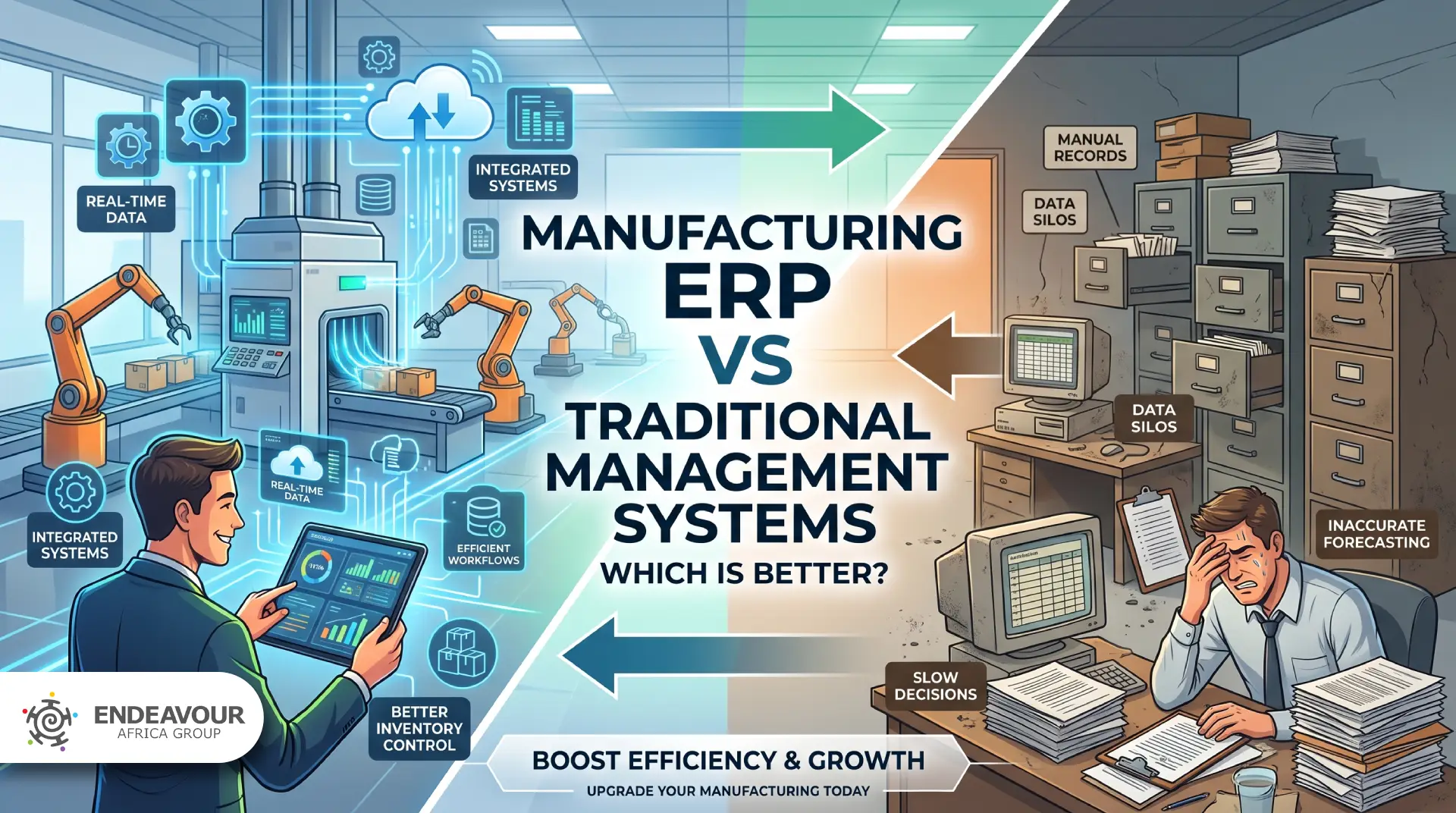
Manufacturing businesses in Kenya are facing increasing pressure to improve efficiency, reduce operational costs, and meet customer expectations. While many companies still rely on spreadsheets, paper records, or standalone software to manage their operations, these traditional management systems often struggle to keep up with modern manufacturing demands.
Today, more businesses are adopting Manufacturing ERP Software to automate workflows, improve visibility, and streamline production processes. But how does an ERP system compare to traditional management methods?
In this article, we’ll compare Manufacturing ERP with traditional management systems and explain why more manufacturers are choosing EnQuest ERP by Endeavour Africa to support their digital transformation.
What Is a Traditional Management System?
Traditional management systems typically involve using separate tools for different business functions. For example:
- Excel spreadsheets for inventory
- Manual production schedules
- Paper-based purchase orders
- Standalone accounting software
- Separate payroll systems
- Manual stock registers
While these methods may work for very small businesses, they become inefficient as operations grow.
What Is Manufacturing ERP Software?
Manufacturing ERP Software is an integrated platform that connects every department within a manufacturing business. Instead of using multiple disconnected systems, all data is stored in one centralized database.
A Manufacturing ERP System typically manages:
- Production Planning
- Inventory Management
- Procurement
- Warehouse Management
- Bill of Materials (BOM)
- Quality Control
- Sales & Distribution
- Finance & Accounting
- HRMS & Payroll
- Business Reporting
This allows every department to work with real-time information and improves overall business efficiency.
Manufacturing ERP vs Traditional Management Systems
Production Planning
Traditional systems often rely on manual scheduling, making it difficult to track production progress or respond quickly to changes.
With ERP for Manufacturing, production schedules are automated, work orders are tracked in real time, and managers can monitor machine and workforce utilization from a single dashboard.
Inventory Management
Manual inventory tracking often results in stock shortages, excess inventory, and inaccurate records.
ERP software provides real-time inventory visibility, helping businesses manage raw materials, work-in-progress, and finished goods more accurately.
Procurement
Traditional purchasing processes involve paperwork and manual approvals, which can delay production.
ERP software automates purchase requisitions, purchase orders, supplier management, and delivery tracking, ensuring materials are available when needed.
Production Costing
Calculating manufacturing costs manually can be time-consuming and prone to errors.
ERP automatically calculates material costs, labor costs, machine costs, and overhead expenses, giving manufacturers accurate product costing and profitability analysis.
Quality Control
Traditional systems often record quality inspections manually, making it difficult to identify recurring issues.
ERP software integrates quality control throughout the production process with inspection records, defect tracking, and quality reports.
Reporting & Business Insights
Manual reporting requires collecting data from multiple departments, often resulting in outdated information.
ERP provides real-time dashboards showing:
- Production Performance
- Inventory Levels
- Sales Reports
- Procurement Status
- Financial Performance
- Manufacturing Costs
Managers can make faster, data-driven decisions.
Key Benefits of Manufacturing ERP Software
Switching to a Manufacturing ERP System provides several business advantages:
Increased Productivity
Automate repetitive tasks and reduce manual data entry.
Better Inventory Control
Track stock levels in real time and prevent shortages or overstocking.
Faster Production
Improve production planning and reduce manufacturing delays.
Improved Collaboration
Production, inventory, procurement, finance, and sales teams all work from the same system.
Reduced Operational Costs
Eliminate duplicate work, minimize material waste, and improve resource utilization.
Better Customer Service
Deliver orders on time with accurate production and inventory planning.
Why Traditional Systems Are No Longer Enough
As manufacturing businesses grow, traditional systems become difficult to manage because they:
- Require duplicate data entry
- Increase the risk of human error
- Lack real-time reporting
- Create communication gaps between departments
- Make business scaling more challenging
An integrated ERP solution eliminates these limitations by providing one centralized platform for managing all manufacturing operations.
Why Manufacturers in Kenya Are Choosing EnQuest ERP
EnQuest ERP by Endeavour Africa is designed to help manufacturers improve efficiency, reduce costs, and gain complete control over their operations.
Key features include:
- Production Planning
- Inventory Management
- Procurement Management
- Warehouse Management
- Bill of Materials (BOM)
- Quality Control
- Finance & Accounting
- Sales & Distribution
- HRMS & Payroll Integration
- Real-Time Business Dashboards
Whether you’re operating a single factory or multiple manufacturing locations, EnQuest ERP provides the flexibility and scalability needed to support business growth.
Which Industries Can Benefit?
EnQuest ERP is suitable for a wide range of manufacturing industries, including:
- Plastic Manufacturing
- Clothing & Apparel Manufacturing
- Oil Manufacturing
- Food Processing
- Pharmaceutical Manufacturing
- Chemical Manufacturing
- Packaging
- Furniture Manufacturing
- Metal Fabrication
- Consumer Goods Manufacturing
Conclusion
When comparing Manufacturing ERP Software with traditional management systems, the difference is clear. Traditional methods may work for small operations, but they often lead to inefficiencies, limited visibility, and higher operational costs as businesses grow.
A modern ERP for Manufacturing provides centralized data, automated workflows, real-time reporting, and better collaboration across departments. These capabilities help manufacturers improve productivity, reduce costs, and make faster business decisions.
If you’re looking to modernize your manufacturing operations, EnQuest ERP by Endeavour Africa offers a comprehensive solution tailored to the needs of manufacturers in Kenya. By replacing manual processes with an integrated ERP platform, your business can improve efficiency today while preparing for future growth.
Frequently Asked Questions
What is the difference between Manufacturing ERP and traditional management systems?
Traditional systems use separate tools and manual processes for different departments, while Manufacturing ERP integrates production, inventory, procurement, finance, and sales into one centralized platform.
Is Manufacturing ERP suitable for small manufacturers?
Yes. EnQuest ERP is scalable and supports small, medium, and large manufacturing businesses.
How does ERP improve manufacturing efficiency?
ERP automates production planning, inventory management, procurement, costing, and reporting, helping businesses reduce manual work and improve productivity.
Can Manufacturing ERP integrate with HR and Payroll?
Yes. EnQuest ERP integrates seamlessly with HRMS, Payroll, Finance, Inventory, Procurement, and Manufacturing modules.
Comments are closed